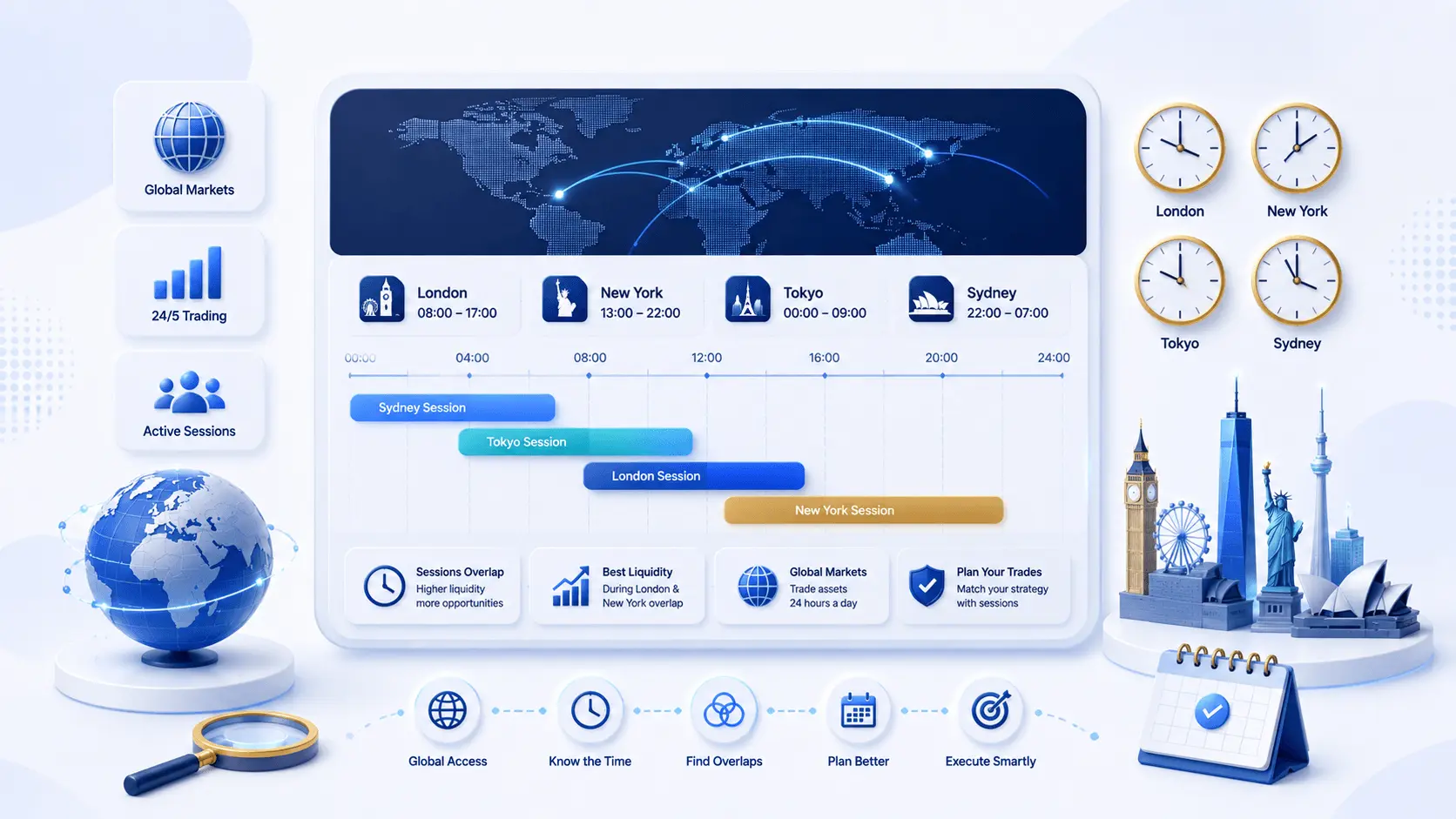
The forex market does not have one central exchange with a single opening and closing bell. Because it is a global, decentralized market, trading happens continuously across different financial centers as the sun rises and sets around the world.
To understand how this works, traders look at forex trading sessions. A forex session describes the main business hours of a major regional financial center. Understanding what forex trading sessions are helps beginners recognize why market activity, liquidity, and spreads change depending on the time of day.
What Does Forex Trading Session Mean?
A forex trading session refers to the period when a major global financial center is open for normal business. While retail traders can place trades almost any time during the trading week, institutional volume (like banks, funds, and corporate trading) usually peaks during these local business hours.
Instead of tracking dozens of individual cities, the forex market is commonly divided into four major sessions that follow the sun.
| Order | Session | Region |
|---|---|---|
| 1 | Sydney | Australia / Pacific |
| 2 | Tokyo | Asia |
| 3 | London | Europe |
| 4 | New York | North America |
Why Forex Has Multiple Trading Sessions
Because businesses, governments, and travelers need to exchange currency globally, the market cannot sleep. When banks in Tokyo are closing for the day, banks in London are just starting their morning. When London is wrapping up, New York is active.
The Four Major Forex Trading Sessions
The four major sessions are practical references. They are not strict exchange hours, but general timeframes used to track regional liquidity.
Forex Session Times: Reference Table
Session times are often displayed in UTC (Coordinated Universal Time) as a neutral baseline. However, these are reference times and may differ depending on the source, daylight saving time (summer/winter shifts), and broker schedules.
| Session | Common UTC Reference |
|---|---|
| Sydney | 21:00–06:00 UTC |
| Tokyo | 00:00–09:00 UTC |
| London | 07:00–16:00 UTC |
| New York | 13:00–22:00 UTC |
What Is a Market Overlap?
A market overlap happens when two major sessions are open at the same time.
The most famous overlap is the London / New York overlap. This period (when afternoon in London overlaps with morning in New York) often sees the highest trading volume, tightest spreads, and significant price action.
Why Liquidity Changes by Session
Liquidity means how easily an asset can be bought or sold without causing a big price change.
During peak sessions or overlaps, many traders, banks, and funds are participating. This usually means higher liquidity and tighter spreads. During the quiet hours between sessions (like late New York afternoon before Sydney opens), fewer participants are trading. This can lead to lower liquidity, slower movement, or occasionally wider spreads and sudden, thin-market volatility.
Forex Sessions and Currency Pairs
Some traders prefer to trade specific pairs when the related region is awake and active.
| Session | Pairs Beginners Often Watch for Activity |
|---|---|
| Sydney | AUD/USD, NZD/USD, AUD/JPY |
| Tokyo | USD/JPY, EUR/JPY, AUD/JPY |
| London | EUR/USD, GBP/USD, EUR/GBP, USD/CHF |
| New York | EUR/USD, GBP/USD, USD/CAD, USD/JPY |
Common Beginner Mistake
A common beginner mistake is thinking:
“Forex is open 24 hours, so every hour is equally good for trading.”
This is not correct. The market may be open, but activity levels change. Some hours may have wider spreads, lower liquidity, or slower movement. Other hours may have faster movement and higher volatility.
Another mistake is using a session table without converting it correctly into local time. Daylight saving time can shift displayed session times. A better habit is to use a timezone-aware converter and check broker platform hours before planning trades.
When to Use the Forex Session Converter
Open Forex Session Converter
Key Takeaways
Summary
- Forex trading sessions divide the global forex day into major regional windows.
- The four major sessions are Sydney, Tokyo, London, and New York.
- Forex is decentralized, so session times are practical references, not one universal exchange schedule.
- Session times may shift because of daylight saving time and broker/platform rules.
- Market overlaps can bring higher activity, especially London/New York.
- Liquidity, spreads, and volatility may vary by session and instrument.
- A Forex Session Converter helps show session times in a user-selected timezone.
- Session timing is educational context, not trading advice.