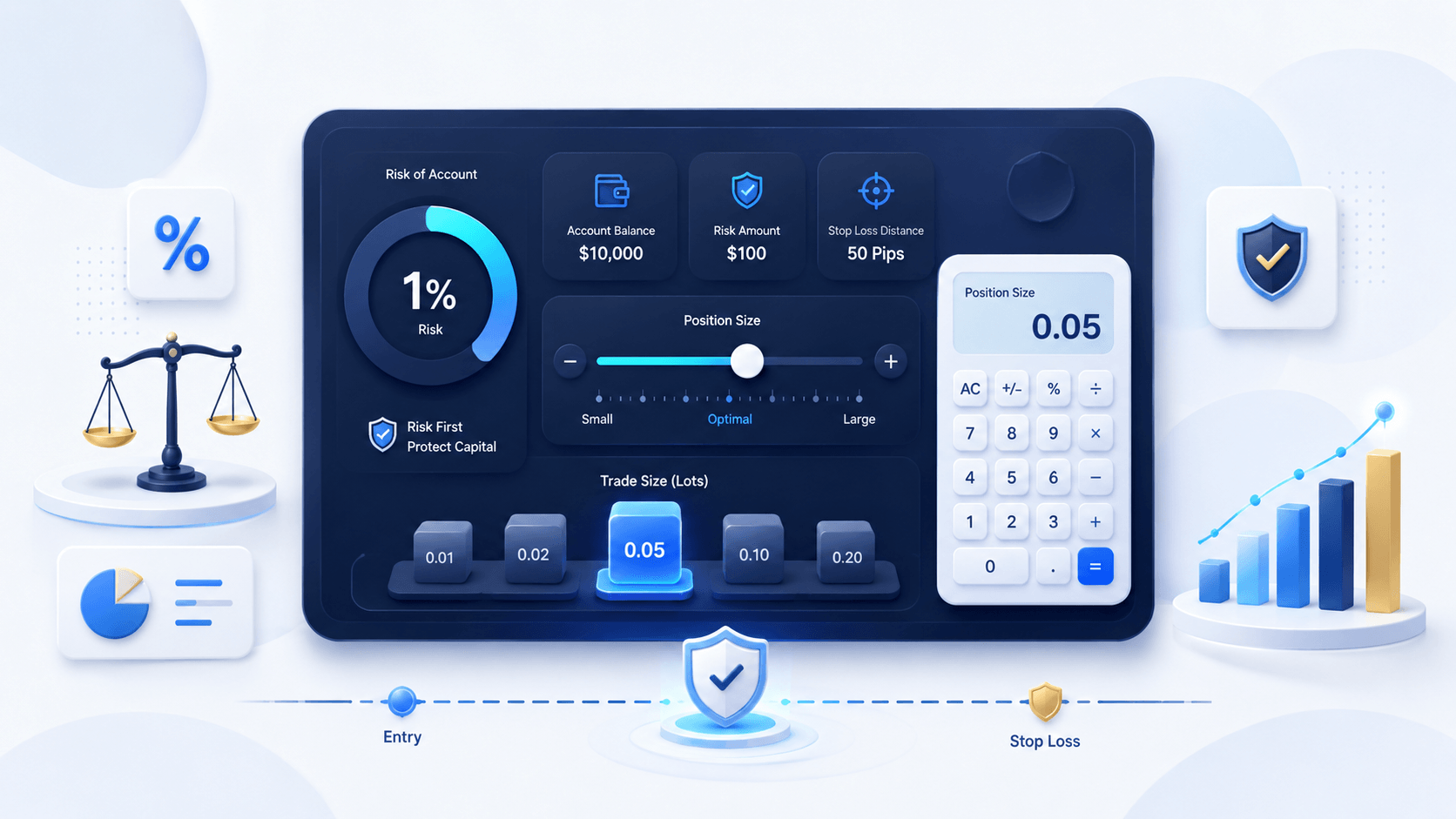
Position size in trading means the amount of a market you choose to buy or sell in one trade. In forex, this may be shown as units or lots. In crypto, it may be shown as coins, tokens, or contract size. In gold/XAUUSD, it may depend on the broker’s lot or contract specification.
Understanding what position size is in trading is important because it connects your account balance, risk amount, and stop-loss distance. A position size does not tell you whether a trade will win. It only helps estimate how large or small a trade may be based on selected risk assumptions.
What Does Position Size Mean in Trading?
Position size is the size of a single trade. It answers a basic question:
“How much am I trading on this position?”
| Market | Position size may appear as |
|---|---|
| Forex | Units, micro lots, mini lots, standard lots |
| Crypto | Coin amount, token amount, contract quantity |
| Gold/XAUUSD | Lots, ounces, or contract size depending on broker |
| Stocks | Number of shares |
Why Position Size Matters for Risk Management
Position size is one of the most practical parts of trading risk management. It helps traders avoid taking a trade that is too large compared with their account balance.
A trade can be risky for two reasons:
- The stop loss is far from the entry price
- The position size is too large
The Simple Position Size Formula
A basic position size estimate uses these main inputs:
- Account balance
- Risk percentage or risk amount
- Stop-loss distance
- Value per point, pip, unit, or contract
Position Size Example
Let’s use a simple educational example.
Assume:
- Account balance: $2,000
- Risk selected: 1%
- Risk amount: $20
- Stop-loss distance: 50 pips
- Estimated pip value per standard lot: $10 per pip
If 1 standard lot moves $10 per pip, then a 50-pip stop would equal:
50 pips × $10 = $500 risk per 1 standard lot
But the trader only wants to risk $20.
So:
$20 ÷ $500 = 0.04 standard lots
In this example, the estimated position size is 0.04 standard lots, assuming the pip value and lot rules match the selected instrument and account setup.
This is a reference calculation only. Actual results may vary because of spread, slippage, execution price, account currency conversion, broker rules, and market movement.
Position Size in Forex, Crypto, and Gold
Position sizing works across different markets, but the details are not always the same.
Common Beginner Mistake
A common beginner mistake is choosing position size based on expected profit instead of risk.
For example, using the same lot size with different stop-loss distances can create very different risk.
| Trade | Stop-Loss Distance | Same Lot Size? | Risk Result |
|---|---|---|---|
| Trade A | 20 pips | Yes | Lower risk |
| Trade B | 100 pips | Yes | Much higher risk |
When to Use the Position Size Calculator
Open Position Size Calculator
Key Takeaways
Summary
- Position size means how large a trade is.
- It connects account balance, risk amount, stop-loss distance, and value assumptions.
- A larger position size increases both potential profit and potential loss.
- A wider stop loss usually requires a smaller position size if the risk amount stays the same.
- Forex, crypto, and gold position sizing can differ by broker, exchange, contract, and account type.
- A position size calculator is useful for reference calculations, but it does not predict trade outcome.
- Trading involves risk, and actual results may vary.