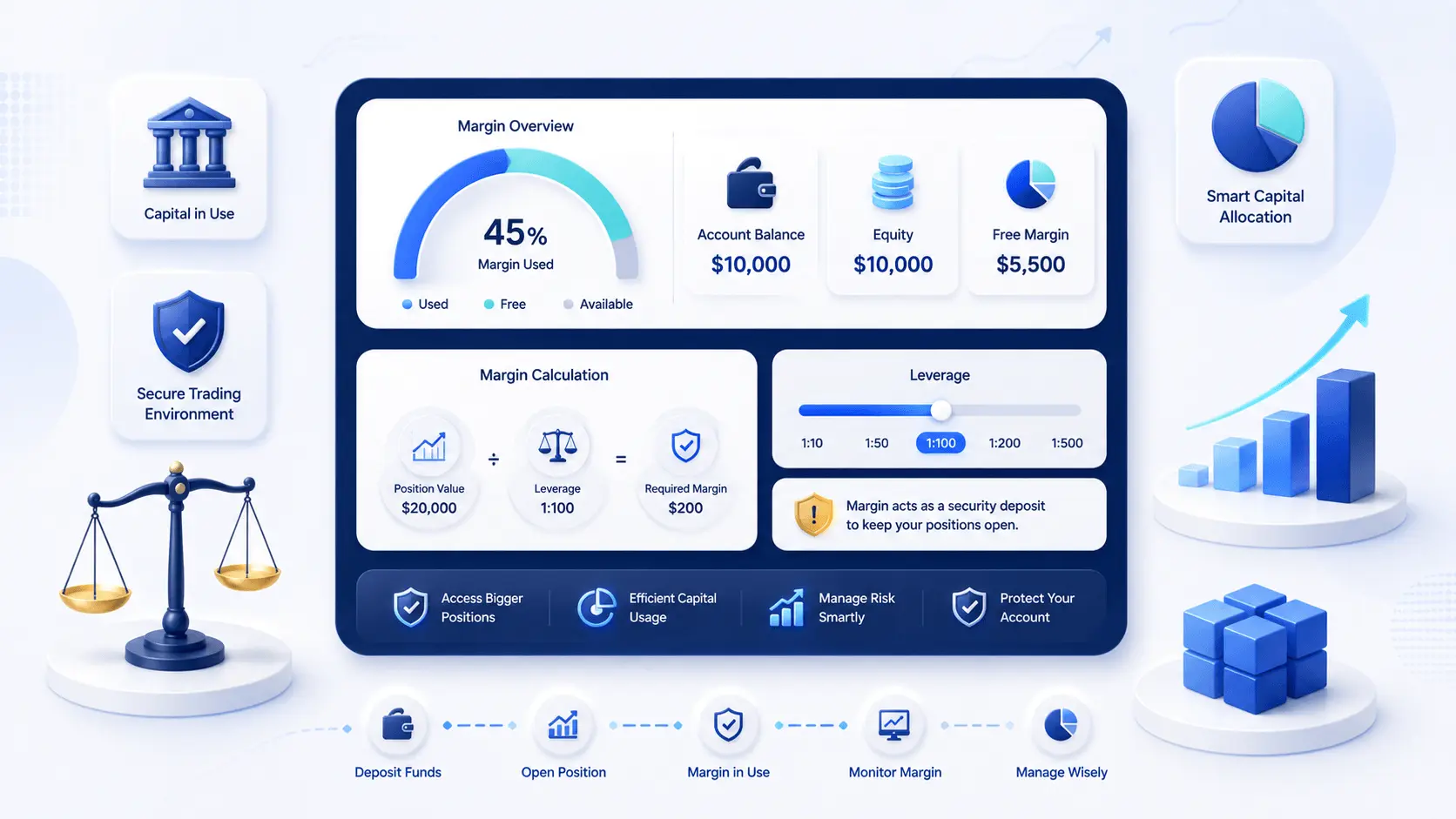
Margin in trading is the amount of money required as collateral to open or hold a leveraged trading position. It allows traders to control a larger trade value with a smaller amount of capital.
Understanding what margin is in trading helps beginners understand how much account equity is locked during a trade, how leverage affects the required amount, and why calculating margin is part of risk management.
What Does Margin Mean in Trading?
In leveraged trading, margin acts as a good-faith deposit. When you open a position, the broker or exchange sets aside a portion of your account balance to cover the risk of the trade.
Think of margin as a security deposit, not a purchase price. You are not "buying" the asset outright with the margin amount; you are providing collateral to control the contract.
Margin Is Not a Fee
A very common beginner question is: "Is margin a fee?"
No. Margin is usually not a fee. It is money that belongs to you, but it is locked while the trade is open. When the trade is closed, the margin is released back to your available balance, minus any losses or plus any profits.
| Item | Meaning |
|---|---|
| Margin | Collateral required to open/hold a position |
| Spread | Difference between buy and sell price |
| Commission | Broker/exchange trading charge |
| Swap/Funding | Overnight or periodic financing cost |
| Profit/Loss | Result of market movement after costs |
Why Margin Matters
Margin matters because it limits how many trades you can open and how large they can be. If you do not have enough available margin, the platform will not let you open the trade. If a trade moves against you and your equity drops too low, you may face a margin call or liquidation.
Margin and Leverage Relationship
Margin and leverage are connected. They describe the same relationship in different ways.
- Leverage is expressed as a ratio (e.g., 50:1).
- Margin is expressed as a percentage (e.g., 2%).
| Leverage | Margin Requirement |
|---|---|
| 10:1 | 10% |
| 20:1 | 5% |
| 50:1 | 2% |
| 100:1 | 1% |
Simple Margin Formula
There are two common ways to estimate required margin:
Required Margin = Trade Value × Margin RequirementMargin Example
Let’s look at an educational calculation example.
- Trade value: $100,000
- Leverage: 50:1
- Margin requirement: 2%
Margin in Forex, Crypto, and Gold
Margin rules often change depending on the market and the broker.
Common Beginner Mistake
A common beginner mistake is thinking:
“If the margin required is only $100, then my risk is only $100.”
This is not correct. Margin is collateral required to open the position. Margin is not the same as maximum loss.
A trade may lose more or less than the margin amount depending on position size, price movement, stop-loss distance, slippage, spread, commission, funding, liquidation rules, and market gaps.
Another mistake is using the highest available leverage just because the platform allows it. A better habit is to calculate position size and risk first, then check margin requirement.
When to Use the Margin Calculator
Open Margin Calculator
Key Takeaways
Summary
- Margin is the required collateral for a leveraged trade.
- Margin is usually not a fee.
- Leverage allows a trader to control a larger trade value with a smaller margin amount.
- Required margin can be calculated using trade value and margin requirement.
- Higher leverage lowers required margin but can increase risk exposure.
- Margin rules may vary by broker, exchange, instrument, region, and account type.
- Margin should be used together with position size, stop loss, and risk planning.
- A margin calculator is useful for reference calculations, not trading advice.